A Look Back at Fond Memories

From what I remember from our first meeting, my Silver Club partner and I were very, quiet and awkward with one another. I was full of nerves and deathly afraid she wouldn’t like me and that we would have nothing to talk about. But little did I know that meeting with her week after week, I would gain such a wonderful and pleasant friendship with my member.

During our meetings, she and I would talk whilst doing art, discussing her childhood, teasing each other about the men in our lives (or ones we soon hoped would be!), my college life and the best part: we would sing together. Each week I went, I would find out something new about her she had never told me before and also remember the stories she recounted to me earlier. Our conversations were ones that were lively, full of laughter, and sometimes some silence too. Both of us developed a nice rhythm with one another, a comfortable rapport and silence in which both of us understood each other and became a part of our weekly interactions. With this, our friendship has grown, and I cannot be happier.

When I signed up for this class, I was extremely curious about dementia and how it affects somebody’s life. Since I’ve only had one experience with it in my family, I wondered what it would be like in the lives of others’. After working with my Silver Club partner and learning all that we have by taking this class, it is clear that some things never will be the same when dementia affects someone. Yet, I’ve realized that dementia brings out so much in a person in a different way.

On our last day, we had the exhibition of all of the Silver Club and Elderberry members’ artwork that we had completed during the semester. Looking back, I couldn’t have been more proud. The hard work and dedication our partners have put in to our weekly meetings throughout the entire semester were up on easels and were a sight to behold. I was so excited to take my Silver Club partner and show her the work we had created together displayed so nicely amongst all the work that was there. Everyone’s work looked fantastic and was definitely a great self-esteem boost for every member who saw his or her work in such a formal setting. Overall, I have to say it was a wonderful experience for everyone who attended.

I want to personally thank my Silver Club partner for all that she has been to me. She has become a great friend and I am so happy to have met her. I would also like to thank the Silver Club and Elderberry members and all the staff who helped us. Thank you so much for making this experience the best it can be. I know for sure that I would like to come back and I can’t wait till I do.

~Aditi, University of Michigan Student
Connecting through song

The last palindromic day of the year (3/19/13) was the first day of my collaborative project with my Elderberry partner. Throughout the semester, she often brought up the established hobbies in her life: gardening, cooking, vegetarianism, painting, but above all, singing. After learning this, one day I tried singing some Beatles tunes with her, and was pleasantly surprised to find that she remembered the lyrics to Blackbird. She remarked, “I’m so glad to know young people are still singing things like that,” which made me laugh, and I assured her that we young people knew all about the Beatles.
Therefore, when the time came for us to plan our collaborative projects, I decided I would learn some Beatles songs and, manned with my guitar, sing with my partner.
I was really nervous, anticipating that she wouldn’t enjoy the activity, or wouldn’t remember any of the lyrics and I would end up serenading her, which I would have enjoyed, but I wasn’t sure that she would. However, everything ended up being fine. I strummed, and we sang, and during the choruses of certain songs, I was delighted by how her voice rang out, and I could tell she radiated happiness.
That day was a little different from previous sessions where we worked together on paintings, collages, and the like. Though she enjoyed spending time together and creating art, I could tell on that first day of our collaborative project, my partner was genuinely happy. I could tell that singing is what she uninhibitedly enjoys.
This experience made me realize that it didn’t matter if my partner remembered the lyrics or not. She simply enjoyed the act of singing, sharing in a musical experience and letting her voice ring out. I had been so hung up on making sure to print the lyrics in a big enough font and organizing the papers while we were singing. However, halfway through the hour, I realized I needed to just let it go and put the papers down and look at my partner and sing. That’s when we enjoyed it the most, and it reminded me of the importance of relaxing and flexibility in every aspect of life, not just working with a person with Alzheimer’s disease.
Emily Paik, Art & Design and Psychology student

Being inspired

Today was probably my most rewarding day yet at the Elderberry Club.

The Elderberry partner that I work with is not far along in her prognosis; therefore we are able to maintain good conversation throughout the time we spend together, and she discusses what she knows will be coming in the near future.  We have fun conversations as well as very real ones.  My Elderberry partner normally remembers much of what we discussed the previous week, however she doesn’t always remember much of the artwork we did.  The main thing my partner does remember is the positive experience of spending time together.

Today we worked on a piece of art, but spent most of the time discussing our families, life experiences, and what comes next for me after college.  However, for the first time at the end of our meeting, my Elderberry partner expressed to me her gratitude and love for the program we are a part of.  She discussed how Tuesday afternoons have been the high light of her past few months, and was so upset that we don’t meet more often and that our collaboration will soon be ending.  She expressed how being creative and talking with me kept her mind off of the disease, and brought a lot of joy to her life.  She also expressed how earlier today the group listened to music from her youth, and that it made her feel so calm, relaxed, and happy for the first time in a while.  In class, we have done many readings about the positive effects the arts have on patients with dementia, but to hear it first hand was a remarkable and enlightening experience.  It also inspired me to continue this kind of work in the future.

Samantha, UM Art & Design and History of Art student 

sm_eb_barbra

Memorizing In Color

When I signed up for this class I knew only a sliver of information on Dementia, mostly consisting of what I now see as stigmas. The readings we discussed in class were helpful to further my knowledge, and even Still Alice was helpful in understanding just how fast one can progress. I learned that the process of memory loss isn’t linear thus there are good and bad days.

Taking this information with me to Elderberry Club I was really surprised the first few visits that my Elderberry partner seemed to be just like any other older adult I knew. She forgot some things, remembered some other things, nothing that seemed out of place to me.  She told me all about her granddaughter and how amazingly wonderful she is.  It wasn’t until the next visit that I realized something was wrong.  She didn’t remember whom this girl was and was puzzled by her presence—it was like the granddaughter she told me all about never existed. That really tore me up, especially being as close as I was to my grandma, I couldn’t imagine what I’d do if she had forgotten me. Even though I wasn’t her granddaughter, I think I may have reacted as if I was, upset for a while after and thinking about how devastating it would be not to remember things of such importance.

There was a light though, that same day she told me that she remembered the bright colors of the week before. I asked her further about what she remembered. She told me she had liked some colors she had seen in someone else’s painting and that day went home and recreated something similar. She mentioned that she was able to visualize bright colors easier, thus that’s why she must remember them.

From working together I learned how picky she can be with colors, she carefully thinks before putting any color down. I may have once thought this was indecision, but after getting to know her passion to carefully decide what color is what, I now know to let her be. She is just as particular as every other artist when picking colors— she wants to consider the consequences of the relationships of one color to the next. Orange flowers are given blue leaves, and when I question why they aren’t green I get the simple response: “this looks better,” and she’s right.

My member is fully capable to produce artwork that I would be proud to make.

~Emily, Art & Design U of M Student 

Singing: Raising the happiness quota

Last Tuesday was probably my favorite day in Silver Club.

This in itself was surprising, since we were short on both staff members and students that day. The collage project planned required lots of cut out pieces of paper, and getting the correct colors and objects to members made things a tad hectic at the beginning. But in no time at all, everyone was settled down plotting out designs for their landscapes and having a grand old time. And that’s when the fun started.

First off, let me say that I have found a kindred spirit in my Silver Club partner. He has a wondrous sense of humor that shines through the art projects, and between the two of us we’re often getting in trouble of some sort. Last Tuesday it started when he heard singing. My roommate Sarah was singing to her partner on the other side of the room, and when the room quieted down we were all able to hear it.

“Whose singing?” said my member.

“Sarah and her partner across the room,” I said.

He contemplated this for a second and said, “We should sing. Louder.”

The other folks at my table and I laughed, thinking he was kidding. I know that he used to enjoy folk festivals with his wife, and was trying to think of some song that we could sing back with, when he broke out into a chorus of ‘I’ve been Working on the Railroad’. Every member joined in, singing it as loud as they could as the students frantically scrambled for words they hadn’t sung since elementary school. Sarah’s Silver Club partner found it hilarious, making the train’s whistle noises when the song called for it.

Singing together in that moment brought the happiness quota already present in the room up several notches, leaving my partner wreathed in smiles. It’s not often that outreach allows us to do things collectively as a group, and it was nice to share that moment with all in the room.  Club Members also thought it funny that students had issues remembering the words.

Afterwards, my member and I talked about the South and the railroads while we worked. Every Tuesday his art astounds me, and this time was no exception. If I could use watercolors like he does, I wouldn’t need art school.

I hope that sometime in the future, we can all sing together again. And I hope I remember more of the words….

~ Meggie Ramm, UM Art & Design Student

sm_silver_club


Designing for others

During an initial discussion of general questions and concerns, a classmate expressed his anxiety of making art with our members because, unlike most students who are artists, he is a designer. While he was reassured that his design abilities would translate into the experience, his expression continued to plague me. It was the catalyst of my own anxieties as a designer. Designers create under specific criterion as dictated by the client, so, ideally, they are effective communicators working with people from all fields and temperaments. If I am able to effectively communicate ideas and concepts through design projects, why is conversation more challenging?

Conversation truly is an art, requiring equal parts of talking and listening. While I claim to be a good listener, I admit talking is more difficult. When meeting new people, I’m often perceived as shy due to my introverted nature. As I begin to speak, I fear that my conversations will only amount to small talk, or seem plain insignificant. Luckily, my Elderberry partner is accepting of my sparse conversation. She too is a quiet person, so we enjoy peoplewatching and eavesdropping. We often share moments of non-verbal conversation, like when we make eye contact and laugh about something we’ve overheard. I think the openness of the space and projects allows for interesting conversations ranging from dating to classes. While we enjoy listening to the conversations around us, I wonder if she would like me to be more talkative.

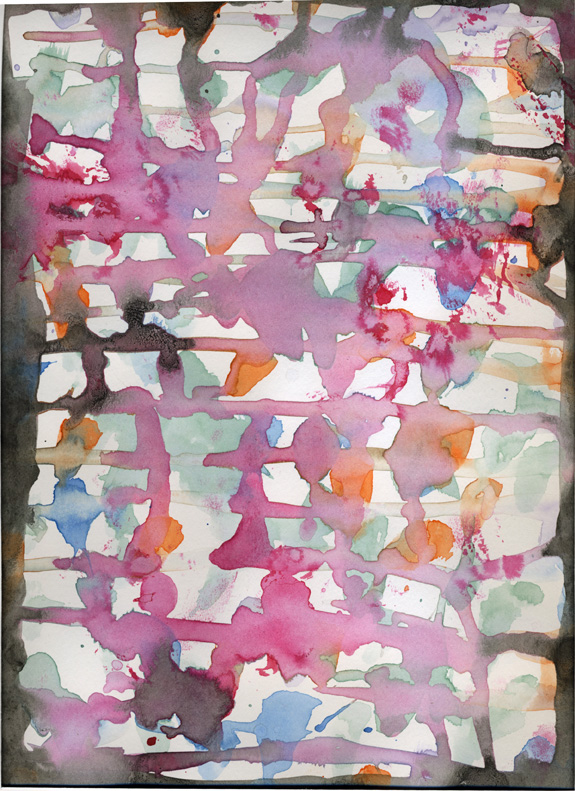
Oddly, the greatest challenge, however, is accepting that my partner has dementia because she doesn’t show outward signs of struggle. She is just as aware of our surroundings as I am, responding in a smile or quiet laugh. Furthermore, she is confident in her creative ability and efficient process, always having time to spare for watercolor painting. She seems to want more challenging projects. Working one-on-one enables me to revise our projects to better suit her needs. In particular, she enjoys painting patterns using a variety of colors. I wonder if our final project will entail watercolors, perhaps on a larger scale.

I had anticipated my experience as an assistant art teacher would translate to working with adults with memory loss, but my experience, thus far, has proved to be completely unique. While my initial anxieties have eased, I wonder what more I can do to create a space and projects more catered to her. I find myself asking, “How can I apply myself as a designer, and individual, to best help my partner?”

~Tery Hung, Art & Design and English Literature student

Beyond the Stereotype

Pop art was the inspiration for two of the projects we did at Silver Club. I discussed color choices with my Silver Club partner. We decided to put the cool colors across from each other diagonally, and then warm colors across from each other. Then I asked her in which room of her home she would display her artwork. I suggested the living room. She dismissed this, saying instead that it would be better to put it in her own room. She could not imagine these rather loud colors would match with her daughter’s more conservative living room décor. It probably would not match at all, but she liked the compliment and I brought a smile to her face.

I carefully held down the stencils as my partner painted them in. She was very deliberate about mixing the paint to just the right consistency and not pressing the brush down so hard that the paint bled. A few times she began to inadvertently paint on the styrofoam stencil instead of on the paper. By the second or third time that she did this, I realized it was because of her memory loss that she could not recall the steps. I remembered this from my training, and also that she might be feeling sensitive and self-conscious about her memory lapses. So I smiled and gently reminded her. She was patient with me, and I was patient with her. Besides, we were having fun.

Once the squares were all painted, we chatted a bit as we allowed them to dry. Then I handed her pieces of double-sided tape to adhere to the backs of the colored paper squares. We then positioned the squares onto black cardstock. It looked amazing, especially considering how people with dementia are stereotyped as being incapable of creativity. My partner beamed with pride as I put her artwork on the wall along with the other projects. We were all gathered in a semi-circle around the artwork. We sat back and looked at all of the artwork on the wall. Some had very good craftsmanship. Some were more abstract. A couple of them also incorporated the white styrofoam stencils themselves into the design. All were unique.

The Silver Club facilitator led the discussion about the artwork, and more than half of the members eagerly participated. She addressed each of them by name and warmly engaged them in a thoughtful and fun discussion of the work. The members were far from the stereotype: old, catatonic, and senile they were not. They were more animated, insightful and pleased with themselves than one might expect a group of older adults with dementia to be. We all agreed when the facilitator suggested that the works collectively resembled a colorful quilt.

This session went very well and it looked like we all had a pleasant time. Before she left, my partner gave me a big hug and told me “I love you”. I am so happy that I can make a difference in her life.

~Marie Belton, BFA Candidate- class of 2013

popart EB- Close up- cartoon Project

Taking down walls: An experience at Elderberry

Reading Alzheimer’s literature it’s hard not to get bogged down in sadness. The illness is one that is takes without remorse, stealing someone’s ability to communicate and remember their loved ones. Yet every time I go to Silver Club and Elderberry, rather than become depressed, I am inspired by the men and women who have this disease. They are people with such colorful personalities, wonderful stories, and positive attitudes.

The member I work with always manages to amaze me with her wisdom and insight. The last time I visited, we talked about the instruments we play. She remarked that although she never had piano lessons, the first time she encountered a piano, she sat down and played it with surprising ease. Her relatives were amazed, but she just tried to play what felt natural. I told her that I’m not very musically talented and am hesitant to try different instruments, but she didn’t accept that answer. “Isn’t that you putting up walls? You should always try and if it sounds horrible, oh well!”

I was amazed by her insight and fearless attitude; she challenged me and made me realize that my hesitancy was an expression of fear.  She, who has every reason to put up walls if she wanted to, was telling me to let go of my fear and try new things. It was an inspiring moment, and one that made me examine how I live my life.

Every time we visit, the member I work with thanks me for coming, but this moment showed me how much I have to gain from this experience. Sharing art and life experiences through this class has affirmed to me that while Alzheimer’s is a condition that takes, the people who have it still have a lot to give.

~ Deena Etter, Student of Cultural Anthropology 

Finding Humor

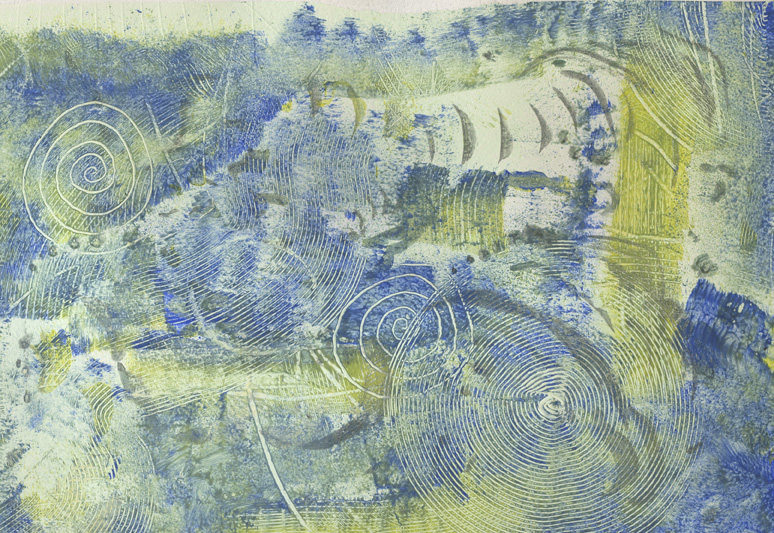
Today, my Elderberry Club partner and I worked on the ‘Additive and Subtractive’ painting project. For the additive piece, she wanted to draw her cat. However, what first started out as a cat turned into this really abstract painting composed of dots and spirals. She was joking about how she stopped drawing her cat when she got to its belly and butt. I actually really liked the change of aesthetic. I think that made the piece much more intriguing and artistic.

There was a funny miscommunication during our critique because of this change of subject matter. The staff leader asked us what her pieces were about, as they were very gestural and abstract. My partner immediately replied “Well, it’s a painting of my cat’s butt!” Everyone laughed because it was such an unexpected response and because the pieces hanging up looked nothing like what she claimed it was! The laughter was nice moment in our critique and a reminder for us all not to take our art so seriously.

~Grace, Art & Design student

gracegrace2

A Study in Individual Style

My two members never cease to surprise me with their creativity and positive attitudes. The great thing is that that is where the similarities between them end, because they are very different individuals with very distinct styles.

I noticed this right upon meeting them. The first member always takes a moment to pause and think about where to make her mark on the page. After a few pensive and still moments, you can always count on her to say that the image “needs something.” Her work tends to be minimalist, orderly and thoughtful, and she rarely needs suggestions. Her pace tends to be very slow and steady since she balances her creative time with careful planning and thinking.

On the other hand, the other member attacks each new project with unbridled zeal and joy. He often does two or even three pieces in the short amount of time that we are allotted.  He has a little more trouble with fine motor skills, but paired with his outstanding energy and attitude, this often results in very free marks in his work. I’ve noticed that he responds really well to and is open to minimal suggestions, such as how to manipulate media in a different way.

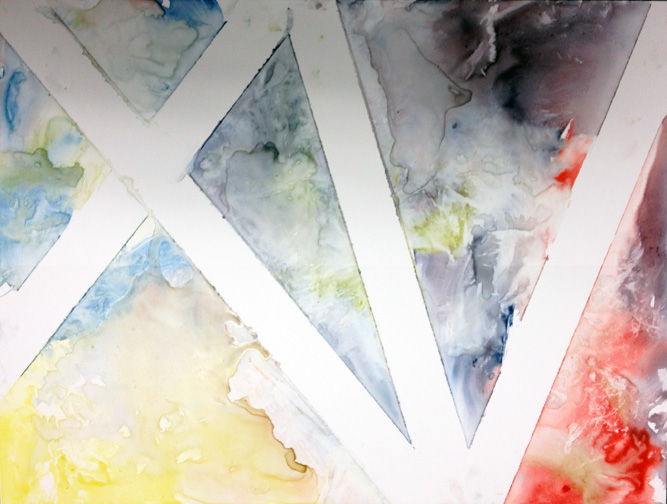
After observing this for a few weeks, I decided to tailor a particular project to the way each of them likes to work. It was a simple Mondrian-inspired piece that involved taping the paper off into rectangular sections and painting with primary colors. For the female member, I made sure to make more boxes for her to fill in because I knew she would enjoy organizing the colors, while I gave the other member larger spaces because he enjoys the act of painting more than planning. I also gave each of them different tools. The precision-driven member was given fast-drying paper and a small brush ideal for the exact marks that are a hallmark of her style. Conversely, the stylistically energetic member was given slow-drying Yupo paper so he could make printed patterns with paper towels and other materials after painting. Both members really seemed to enjoy themselves, and the work they made that day really showcased their respective styles.

-Megan Mulholland, Art & Design student